
Bioidentical Hormone Therapy: What Women Deserve to Understand About Hormones, Menopause, and the “Natural” Hormone Myth
Bioidentical Hormones: What the Term Actually Means and Why the Conversation Deserves More Honesty
When hormones shift during perimenopause and menopause, the effects can touch nearly every part of a woman's life. Energy changes. Sleep changes. Mood changes. Libido changes. The brain feels different. The body feels different. Even a woman's relationship to herself can quietly shift in ways that are hard to name but impossible to ignore.
And yet women are routinely told this is simply something they should tolerate.
I fundamentally disagree.
Hormone therapy can be an incredibly valuable tool — not only for symptom relief, but for supporting long-term health, vitality, sexuality, cognition, bone density, cardiovascular health, and overall quality of life. But there is also a tremendous amount of confusion surrounding these treatments, especially around the word "bioidentical." That word has been stretched, marketed, and misused to the point where it means something different depending on who's saying it.
So let's talk honestly about what it actually means.
What "Bioidentical" Does and Doesn't Mean
Bioidentical simply means that the hormone molecule is structurally identical to the hormone your body naturally produces. Bioidentical estradiol has the same molecular structure as the estradiol made by human ovaries. Bioidentical progesterone mirrors the progesterone your body naturally makes.
What it does not mean is that these hormones are magically natural, untouched, or inherently safer than other options. This is one of the most persistent misconceptions in menopause medicine. Most bioidentical hormones are manufactured in laboratories. Many begin with plant sterols derived from soy or yams, but the final product undergoes extensive chemical processing before becoming a medically usable hormone. These are pharmaceutical products. The term bioidentical refers to molecular structure — nothing more.
Here is where it gets genuinely interesting: one of the oldest and most widely used forms of estrogen therapy, conjugated equine estrogen — marketed as Premarin — is derived from the urine of pregnant mares. The name itself comes from PREgnant MARes urINe. These estrogens are biologically derived, which some would call "natural," but they are not bioidentical to human estrogen. They contain a mixture of equine estrogens that differ structurally from anything human ovaries produce.

Awkward white mare humorously illustrating the origins of Premarin, named for PREgnant MARes urINe, in a discussion about hormone therapy and menopause medicine.
Meanwhile, many so-called synthetic hormones are structurally identical to the ones your body makes.
This is why the natural-versus-synthetic conversation collapses under scrutiny. The more useful questions are whether a hormone is physiologically appropriate for this individual, how it is absorbed, what the actual risks and benefits are, and whether the treatment is personalized. Not whether the label sounds wholesome.
Progesterone and Progestins Are Not the Same Thing
This distinction may be the most important one in all of hormone medicine, and it is almost never explained clearly.
Progesterone is the bioidentical hormone naturally produced by the ovaries after ovulation. Micronized progesterone — often prescribed as oral progesterone — is structurally identical to what the human body makes. Progestins, on the other hand, are synthetic compounds designed to behave similarly to progesterone but with chemically altered structures. Medroxyprogesterone acetate, norethindrone, and levonorgestrel are all progestins.
These differences matter clinically. Progesterone and progestins do not behave identically in the body, and they do not carry the same risk profiles. Micronized progesterone may have meaningfully different effects on mood, sleep, breast tissue, cardiovascular health, clotting risk, and neurosteroid activity. For some women, progesterone actively improves sleep and nervous system regulation because of how it interacts with GABA receptors in the brain — an effect that synthetic progestins do not replicate in the same way.
This is one reason why many women feel noticeably, sometimes dramatically, different depending on which form they are prescribed.
Hormone Therapy Is About Far More Than Hot Flashes
Reducing menopause care to "treating hot flashes" is one of the most limiting frameworks in women's medicine. Menopause affects bone density, muscle mass, cardiovascular health, insulin sensitivity, cognition, bladder health, vaginal tissue, sexual function, sleep, and nervous system regulation. Hormones are not simply reproductive chemicals — they are signaling molecules that influence nearly every organ system in the body.
Thoughtful hormone care, then, is not about chasing youth or suppressing symptoms. It is about supporting a woman's long-term vitality and function through one of the most significant physiologic transitions of her life.
There Is No Universal Hormone Plan
Some women do beautifully with transdermal estradiol patches. Others absorb gels more effectively. Some need progesterone for sleep and nervous system support. Some benefit meaningfully from testosterone therapy. Others are not good candidates for hormone therapy at all, for reasons that require careful individual evaluation.
The safest and most effective plan depends on personal health history, cardiovascular and clotting risk, migraine history, metabolic health, symptom profile, goals, and individual physiology. Hormone therapy should never feel like assembly-line medicine — it should feel like someone actually looked at you as a whole person.

Dr. Evelin Molina Dacker sitting facing a patient in her exam room.
Why a Functional Medicine Lens Matters Here
I have been a Certified Functional Medicine Provider through the Institute for Functional Medicine since 2015, and that training fundamentally shaped how I practice. Functional medicine asks deeper questions — not simply what medication treats this symptom, but why this is happening, which systems are interacting, and how sleep, stress, inflammation, trauma, nutrition, movement, metabolism, and nervous system health all influence one another.
This matters enormously in menopause care because hormones don't exist in isolation. A woman may come in believing she simply needs hormones, but the full picture might also involve insulin resistance, chronic stress, nervous system dysregulation, muscle loss, sleep deprivation, or burnout. Hormones can be a critical part of the solution, but they rarely work as well as they could when the rest of the picture is ignored.
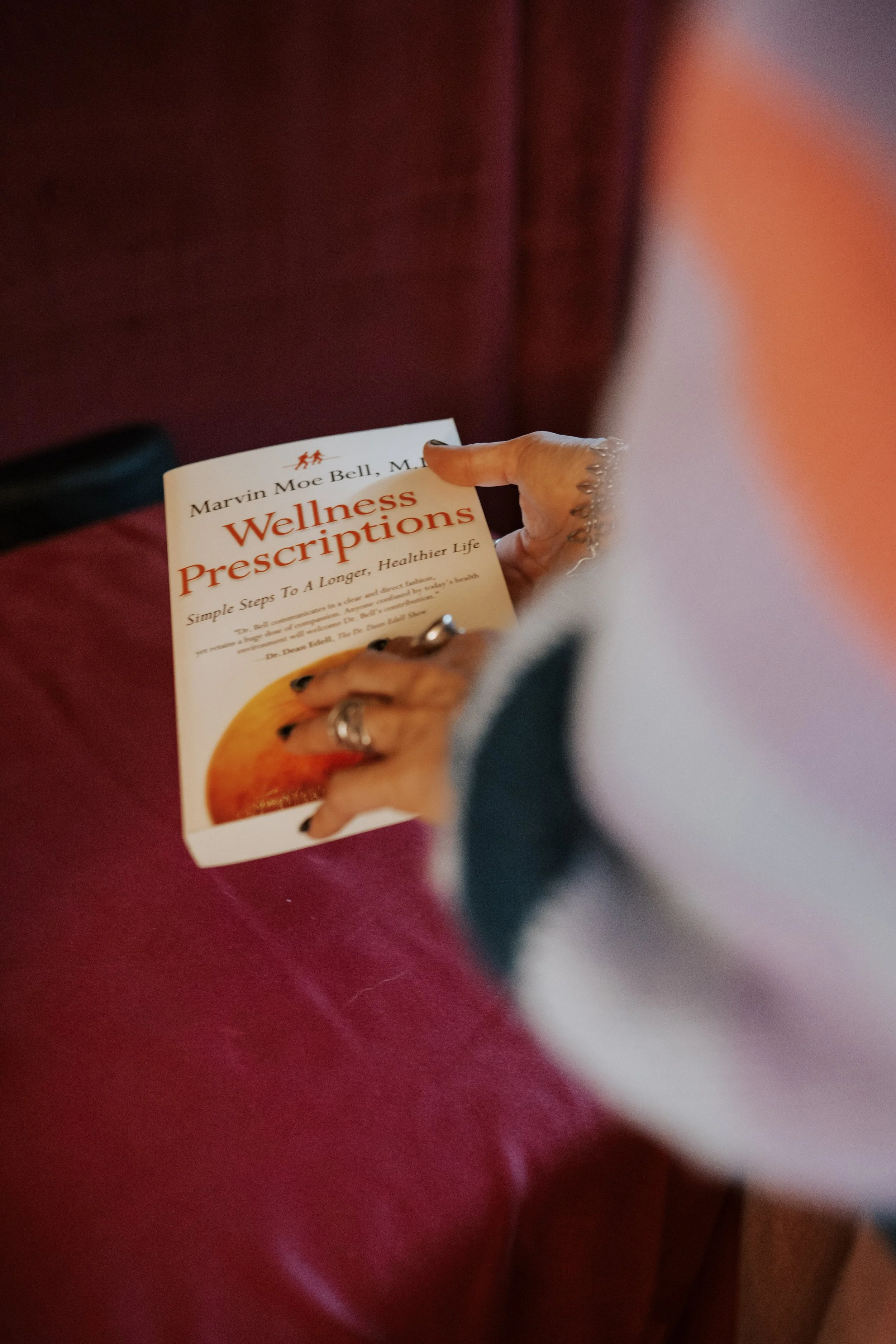
Dr. Evelin Molina Dacker showing a patient a book called “Wellness Prescriptions” by Marvin Moe Bell, M.D.
What Women Actually Deserve
One of the reasons women become vulnerable to misinformation — both the fear-based kind and the wellness-hype kind — is that so many have felt genuinely dismissed by conventional medicine. Told their labs are normal when they feel anything but. Told to try yoga. Told this is just aging.
That dismissal creates a vacuum, and into that vacuum rushes a flood of marketing language dressed up as medicine.
Women deserve something different. They deserve nuanced, evidence-informed conversations about hormones that don't oversimplify in either direction — neither reflexive fear nor uncritical enthusiasm. They deserve to understand that bioidentical doesn't automatically mean natural, that natural doesn't automatically mean safer, and that no single framework applies to every woman's body.
Mostly, they deserve medicine that actually listens — and that treats what is happening in their bodies with the seriousness and complexity it has always warranted.
